
In a beautiful art exhibition in Cyprus during the month of April 2025, for ART.Cy, something extraordinary towered the center aisle, not quite in size, but in imagination. Perched on spindly legs and bearing a festive trumpeter on its back, Salvador Dali Triumphant Elephant sculpture seems to defy the very nature of weight, balance, and realism. It’s not just a sculpture, it’s a oeniric vision immortalized in bronze.
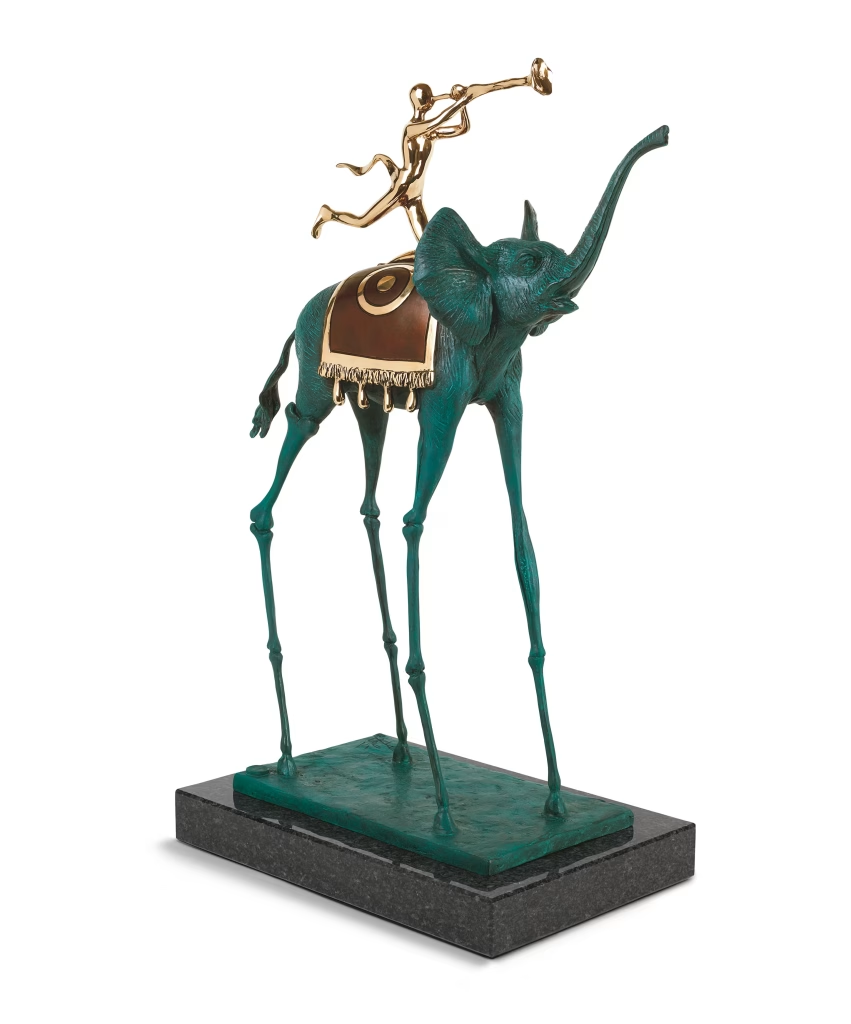
In the kaleidoscopic world of Salvador Dalí, where melting clocks and metamorphic creatures defy time and logic, few symbols are as absurd and majestic as this long and thin legged elephant. With its spindly legs and massive body, the incredible beast has become one of the artist’s most iconic images, an ethereal and surreal vision turned into a solid figure.
Nearly five decades after it was first conceived, Triumphant Elephant continues to stride across the world stage, both literally and metaphorically. From private collections to monumental public installations, from European squares to galleries in Greece and exhibitions in Cyprus, its surreal silhouette heralds the lasting triumph of imagination over convention.
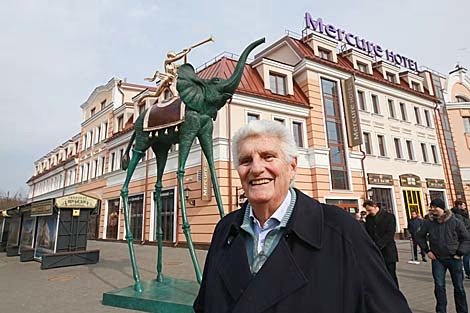
As one of Dalí’s most iconic three-dimensional creations, the Triumphant Elephant captures the essence of his artistic mission: to give form to the subconscious, the mystical, and the impossible. Though Salvador Dali was known primarily for his paintings, his bronze sculptures, and particularly this majestic elephant, demand a closer look, not only for their visual impact but for the world they open into: a world where time melts, animals levitate, and symbols carry the weight of entire philosophies.
This article unpacks the Triumphant Elephant’s symbolism, editions, and history.
The Anatomy of the Impossible
At first glance, Triumphant Elephant appears to be the dream-child of Dalí’s wildest obsessions. A massive elephant stands on gravity-defying, spider-thin legs, reminiscent of the creatures in his 1946 painting The Temptation of St. Anthony. The beast supports an elaborate obelisk on its back, an object that seems both architectural and metaphysical. The contrast between the monumentality of the form and the fragility of its supports creates an unsettling visual paradox, a hallmark of Dalí’s style.
The first encounter with Triumphant Elephant is often one of disbelief. It’s an elephant, certainly, but one imagined by a mind liberated from the constraints of biology, gravity, and time.
The beast towers, its massive body balanced precariously on pencil-thin legs that seem drawn more from arachnid anatomy than any real pachyderm. These surreal stilts evoke an eerie weightlessness, an elephant defying its very nature. And yet, it stands.
Perched atop its back is a gilded saddle studded with precious ornaments, bearing not a rider, but a celestial herald, like an angel, trumpet in hand, frozen mid-fanfare. This angel is no passive passenger. It symbolizes declaration, arrival, transcendence. Together, they announce something grander than a simple march through space. They proclaim a metaphysical conquest.
The elephant, long a symbol of memory and strength in world mythology, is here reimagined as a paradox. It is at once burdened and free, massive and ethereal, a beast of the Earth walking on air. It is ironically undermined by its own impossible structure. Its weight seems unsustainable, yet it marches onward, triumphant. The festive trumpeter adds layers of spiritual ambition and ascension, suggesting a feeling of anticipation of divine revelation.This contradiction is no accident. Dalí invites us to dwell in the dissonance, to feel the surreal tension that animates dreams.
Where other surrealists retreated into the unconscious as a place of fragmentation and chaos, Dalí reached into it with a theatrical hand, staging elaborate symbolic performances. In Triumphant Elephant, that performance becomes a procession—a sacred, slow, and impossible march across the deserts of the dream world.
A March from Canvas to Bronze
Dalí’s long legged elephant first lumbered into public consciousness through his paintings, most notably The Temptation of St. Anthony (1946) and The Elephants (1948). In both, the creature walks on stick-thin legs through dreamlike landscapes, carrying obelisks, towers, and phantoms. These early iterations were purely painterly—the kind of surreal imagery viewers accepted as impossible, precisely because it existed in two dimensions.
But Dalí never stopped expanding his mediums. As he aged, his obsession with physical permanence intensified. In the 1970s and early ’80s, he increased his focus on three dimensional artworks and sculptures, working with editors and master foundries to translate his painted dreams into sculptural form. The Triumphant Elephant emerged from this period as one of his most complete and compelling bronze sculptures. It bridged the iconography of his paintings with the gravitas of classical statuary, creating a surrealist bronze with almost religious intensity.
Today, the sculpture exists in several editions, typically cast in varying physical sizes: monumental, museum-size, and multiple. Each edition retains the original details, from the rough texture of the elephant’s skin to the horse hooves and the shiny trumpet . These limited editions are produced in Switzerland under the strict supervision of the editor by the renowned Perseo art foundry , using the lost-wax technique, a method as ancient as bronze casting and very accurate.
The Language of Symbols
Dalí’s symbolic vocabulary was vast, cultivated from psychoanalysis, mysticism, Catholic ritual, and personal mythology. In Triumphant Elephant, each element performs a layered role. The elephant, in many traditions, is a bearer of wisdom, power, and longevity. But Dalí subverts this by granting it legs as thin as stilts, a visual joke, perhaps, but also a destabilizing metaphor. Can strength really bear its own weight? Is memory ever reliable?
The trumpeting herald perched atop the elephant’s jeweled saddle serves as a jubilant messenger announcing triumph and prosperity. In Dalinian psychology, this figure represents the subconscious that guides humanity through life. The herald’s raised trumpet mirrors the elephant’s triumphantly raised trunk, both proclaiming success and hope for the future. The bejeweled saddle itself symbolizes wealth and the promise of abundance.
The thrust of the trumpeting figure, with the vest flowing in the wind, contrasts dynamically with the elephant’s slow march, creating an interplay between earthly journey and celestial announcement. The herald is poised lightly, balance on a knee, almost impossibly, on the elephant’s back, adding another layer to Dalí’s meditation on weight and weightlessness. This contradiction, the grounded and the elevated, burden and proclamation, is pure Dalí
Even the march itself is symbolic. The elephant strides forward, not toward a destination but through time. In Dalí’s world, time is not linear but looping, dripping, elastic. The Triumphant Elephant is frozen mid-march, like a note held infinitely in a dream.
The Elephant in Dalí’s Imagination
Elephants are not uncommon in the art historical canon, but in Salvador Dalí’s hands, they took on wholly unexpected forms—elevated from mere animals to mythopoetic constructs suspended between dream and divinity.
Their first major appearance in Dalí’s oeuvre is in the cited “The Temptation of St. Anthony” (1946), a seminal oil painting that presents an eerie parade of elephants and horses with impossibly long, spindly legs, each one carrying colossal structures on its back. Here, the elephant becomes a vehicle of temptation and spiritual weight, juxtaposed against the frailty of St. Anthony kneeling in resistance. On two elephants are obelisks, a direct reference to Bernini’s Roman sculpture in the Piazza della Minerva. Another carries a palace surmounted by a trumpeteer, another a nude Venus poised atop a towering golden chalice. These are no ordinary beasts of burden; they are carriers of temptations, represented by these symbols of vice and grandeur, caught in a surreal pilgrimage through the subconscious.
The motif reappears in “The Elephants” (1948), a lesser-known but no less powerful painting where two extremely long-legged elephants march against a dusky sky, their obelisk appearing almost weightless, despite the monumental scale. In both works, Dalí uses the elephant to symbolize the contradiction between weight and levity, permanence and instability. Their attenuated legs evoke frailty, even while they bear the symbolic weight of desire, power, or wealth.
Dalí himself once noted, “The elephant is a distortion in space,” underlining his view of them not as creatures of the natural world, but of dream logic, a logic where gravity fails and meaning is fluid. He repeatedly returned to the motif in drawings, lithographs, and watercolors, including in “Space Elephant” and “Space Triumph” or in the various iterations of the Swan-Elephants. The beasts are endowed with cosmic or spiritual significance, often tethered to stars, trumpets, or deities.
But Dalí’s fascination with elephants extended beyond the painted canvas and bronze cast. In the early 1980s, he received a real elephant from Air India, gifted as a surreal gesture of cultural diplomacy during one of his exhibitions. The story, although sometimes erroneously attributed to the Indian government, is documented in several biographies and press articles. The elephant was flown to Spain, an extraordinary feat at the time, and temporarily housed near Dalí’s home in Portlligat. The artist reportedly named the elephant “Air India” and was both bemused and moved by the gift.
This incident, bizarre yet perfectly Dalinian, only reinforced his mythical bond with the creature. It also symbolized the crossing of boundaries Dalí loved to blur, between reality and fantasy, East and West, art and life. For a man whose life was lived as a performance, being gifted a literal elephant seemed less a diplomatic stunt and more a poetic inevitability.
In this way, the Triumphant Elephant is not a standalone work, but the culmination of decades of visual and philosophical exploration. It is the most fully realized embodiment of an idea that had long walked on stilted legs through the labyrinth of Dalí’s imagination.
A Surreal Stop in Cyprus: ART.Cy and the Dalí Sculptures
In 2025, the surreal became strikingly real when Dalí’s Triumphant Elephant took center stage at ART.Cy, Cyprus’s contemporary art event.
The exhibition of the Salvador Dali sculptures at this event was organized by Massimo Martina, who has been instrumental in showcasing Dalí’s bronzes internationally. According to Martina, “The elephant is about memory, about civilizations carrying the weight of knowledge across time,” he said. “What better place to display it than in Cyprus, a crossroads of civilizations?”
Indeed, the sculpture in Cyprus resonates on multiple levels. The island’s own layered history, Hellenic, Roman, Ottoman, British and its geography between Europe, Asia and Africa, mirrors the symbolic burden the elephant carries. Just as the creature moves forward despite its impossible load, Cyprus continues to navigate its geopolitical, historical and cultural complexity.
the Dlai sculptures at the art event underlined permanence in art. In contrast to the contemporary works dominating ART.Cy’s lineup, Dalí’s bronzes held the weight of tradition, yet remained wild and fascinating, still modern in their message. Their reminded viewers that surrealism isn’t just a 20th-century movement; it’s a living language still capable of startling clarity.
By integrating Dalí into the present moment, the Cyprus exhibition affirmed surrealism’s enduring relevance. And in this Mediterranean context, under a sky bright with historical ghosts, the Dalinian sculptures felt both utterly foreign and completely at home.
Crafted in Bronze, Cast in Memory
Creating Triumphant Elephant was no ordinary artistic endeavor. Like most of Dalí’s bronzes, starting from the artist´s maquette, the sculpture was brought to life by the Perseo Art foundry, in Switzerland, following the lost-wax casting process, a process dating back thousands of years. First, the foundry creates a negative of the initial model used then to form a wax copy and finally encases it in a heat-resistant mold in refractory material. While the mold is heated during the firing to harden the refractory material, the wax melts away, leaving the mold empty and with a cavity shaped exactly like the (now lost) wax copy. The molten bronze is then poured in the mold and fills this void. Once cooled, the bronze sculpture is refined, chiseled, and patinated by hand.
The Triumphant Elephant is edited in 3 sizes, a monumental one, almost 6mt tall and edited in 12 exemplars, a museum sized version, with a height of 265 cm, edited in 12 pieces, and a multiple, edited in 350 + 35EA and 53 cm tall.
Dreams in Three Dimensions: Dalí and Surrealist Sculpture in Context
Though Salvador Dalí is most widely recognized for his paintings, his foray into sculpture marked an essential and often underexplored facet of the surrealist movement. To fully appreciate the Triumphant Elephant and its symbolic power, one must situate it within the broader context of surrealist sculpture, a genre where the physical world is reshaped to reflect the logic of dreams, myth, and the unconscious.
Surrealism, formally launched in Paris in the 1920s by André Breton, found its earliest sculptural expressions not in monumental bronzes, but in assemblage and object art. Artists like Jean Arp and Max Ernst created totems and biomorphic forms that embodied psychic automatism, works driven by chance, intuition, and the subconscious. Their sculptures often avoided the figurative altogether, favoring the ambiguous and organic over the recognizable.
Then came Alberto Giacometti, whose stylized human figures, particularly after his brief alignment with the Surrealists in the early 1930s, reflected psychological alienation and dream logic. His Woman with Her Throat Cut (1932) is a particularly grotesque and unsettling piece, equal parts erotic and violent. For Giacometti and others, sculpture was a space to enact the irrational impulses of the inner world in raw, unfiltered form.
Dalí’s approach to sculpture was fundamentally different. While he shared the Surrealist interest in Freud, dreams, and the irrational, he brought with him a classical discipline and theatricality that was unmatched in the movement. Where other surrealists sculpted from instinct, Dalí sculpted from myth. His works are lush with symbolism, meticulously composed, and almost always rooted in figuration, even if that figuration is stretched, melted, or reconfigured.
Beginning in the late 1930s, Dalí experimented with object-based works like his Lobster Telephone and Venus de Milo with Drawers. These surreal “readymades” owed a clear debt to Marcel Duchamp, but were more playful and less conceptual. It wasn’t until the 1970s, however, that Dalí entered the realm of traditional sculpture in earnest, collaborating with skilled foundries to translate his dreamworld into cast bronze.
Unlike many of his Surrealist contemporaries, Dalí embraced the permanence and grandeur of classical sculpture. While his paintings melted time and space, his sculptures froze them. In works like Nobility of Time, Dance of Time, and Triumphant Elephant, we see Dalí using the medium not to destroy tradition, but to subvert and transform it. He took the solidity of bronze and filled it with paradox.
Dalí’s surrealism in three dimensions was never simply about shock or provocation. It was about creating portals, objects that looked like artifacts from some parallel world. His elephants, clocks, and angels were not merely decorative; they were emissaries from the subconscious, given form and presence.
In this sense, Triumphant Elephant stands at the crossroads of Surrealist sculpture’s evolution. It is at once classical and dreamlike, theatrical and psychological. Its presence in public spaces, not just museums, makes it an ambassador of surrealism’s enduring relevance. Unlike Giacometti’s fragile figures or Ernst’s phantasmagoric forms, Dalí’s elephants stride with operatic grandeur. They are surrealism made majestic.
In many ways, Dalí succeeded where others hesitated: he brought surrealism into the realm of spectacle, without compromising its philosophical core. His sculptures speak not only to the unconscious mind, but to the eye, and in doing so, they bring surrealism out of the shadows of the psyche and into the sunlit stage of cultural memory.
Legacy of the Elephant
Today, Triumphant Elephant marches on, through cities, exhibitions, and the dreams of viewers. Whether encountered in a plaza in Shanghai or a cultural event in Cyprus, the sculpture never loses its power to astonish. It is surrealism made sculpture, and Dalí’s voice made thunderous through bronze.
The elephant does not forget, and neither do we. It reminds us that art can defy reason, embrace contradiction, and still leave footprints that echo long after the parade has passed.